ADDRESS TO THE READERS

PEDAGOGY OF DEVELOPMENT AND COOPERATION
This paper rationales a planned study, the purpose of which is to define the boundaries of professional responsibility of general practitioners (family physicians), as well as to develop algorithms for in ter action between general practitioners (family physicians) and specialist physicians based on expert assessments to improve patient routing in primary care. The study has multicenter, cross- sectional de sign. The methodological basis was current regulatory documents governing professional activity and the list of diseases falling within the professional responsibility of general practitioners (family physicians), as well as expert assessments. Fifty specialists from 13 Russian regions will serve as experts as follows: faculty members from Russian universities training general practitioners (family doctors), district general practitioners (family doctors) of the Moscow Department of Health, chief freelance general practitioners (family doctors) of the Central Federal District of the Russian Federation and other federal districts, as well as physicians with at least 10 years of related experience. The study is structured around 14 independent sub-studies, corresponding to the medical specialties within which the general practitioners (family doctors) practice. Expert assessment cards for work functions were specially developed for each sub-study. A total of 252 diseases are planned to be analyzed. The study will in clude four phases, the last of which is scheduled to be completed in October 2026.
Despite the fact that environmental culture issues are acute for society, environmental education is not sufficiently represented in higher education. The purpose was to assess the formation of the ecological culture of medical students through a specialized discipline of a variable course. A questionnaire was used for 100 medical students to identify the overall level of environmental culture and commitment to environ mental measures. The effectiveness of studying medical ecology in the framework of a variable course, the growth of the general level of environ mental culture of university students, as well as certain sex differences in the activity and value components of environmental culture are shown.
- The issue of foreign nationals' participation in healthcare provision (as physicians and as patients) requires attention from a cultural and medical-anthropological perspective.
- The culture of Muslim countries, as exemplified by Iran, has a significant number of characteristics that can impact all stages of care, from collecting medical history to maintaining adherence to prescriptions.
- Doctors need to be trained in culturally specific communication skills with patients, and migrant doctors need to be trained in the cultural characteristics of Russian residents. Knowledge of languages or direct translation of speech into and out of a foreign language is not enough.
This paper addresses the issue of foreign nationals' participation in providing care in various forms — from foreign patients to physicians who arrived in Russia as migrant workers. The article highlights the cultural specificity of doctor- patient interactions using the example of the Islamic Republic of Iran, with a focus on cardiovascular pathology. This applied medical anthropological study highlights key aspects of legislation, social structure, values, and communication stereotypes that are crucial for understanding the cultural specifics of another country and can have a significant impact on healthcare provision. Such aspects exist in any culture and in any country. Taking these factors into account will improve the quality of care provided to migrant patients and more effectively engage migrant physicians in practice, thereby enhancing not only the quality but also the safety of healthcare services.
THE DIGITAL ENVIRONMENT OF MEDICAL EDUCATION
- A comparative analysis of cardiologists' and functional diagnostics physicians' preferences for continuing medical education (CME) formats was conducted in light of legislative changes restricting distance learning from 2026.
- Following significant interdisciplinary differences were identified: cardiologists rate university-based continuing education programs higher, while functional diagnostics physicians prefer educational activities within the CME system.
- A low rating of interactive educational modules based on key criteria was found among all surveyed physicians.
- The majority of respondents (78,3%) support a blended learning format with a predominantly distance learning component (50-75%).
Aim. To analyze the attitudes of cardiologists and functional diagnostics physicians toward the main formats of postgraduate education (advanced training programs, continuing medical education (CME), and interactive educational modules) in relation to legislative changes restricting distance learning from March 1, 2026.
Material and methods. This cross- sectional study was conducted using an anonymous survey of 148 physicians (90 cardiologists and 42 functional diagnostics physicians) using a standardized 20-question questionnaire. Descriptive statistics and the χ2 test with a significance level of p<0,05 were used for statistical analysis.
Results. Significant differences were found in the perception of various training formats by physicians in the compared groups. Based on a com bination of characteristics (consistency with modern understanding of the subject, usefulness for routine practice, ease of learning), cardiologists rated university- based continuing education programs higher, while functional diagnostics physicians rated CME higher. Interactive educational modules received the lowest ratings across all parameters. The majority of respondents (78,3%) support blended learning with a 50-75% distance learning component.
Conclusion. The study results demonstrate the need for a differentia ted approach to educational programs, taking into account physicians' attitudes toward various learning formats. Legislative changes require adaptive blended learning models that combine practice- oriented training with the use of distance learning technologies.
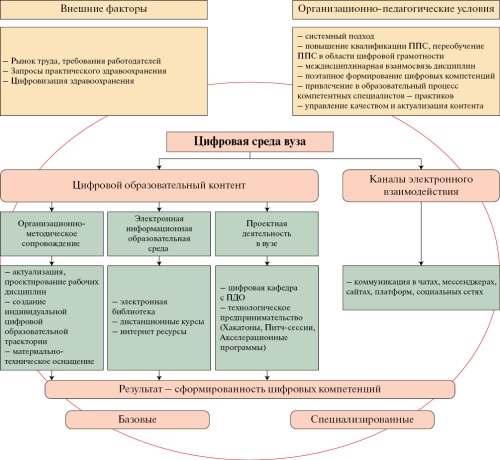
Digital technologies are rapidly penetrating all areas of our lives, and medicine is no exception. This article examines the specifics of implementing digital educational technologies in medical universities in the context of the digitalization of practical healthcare. A model for organizing the educational process is proposed, aimed at training specialists with the necessary digital skills to work effectively in the modern healthcare system.
ПРИНЦИПЫ ВРАЧЕВАНИЯ
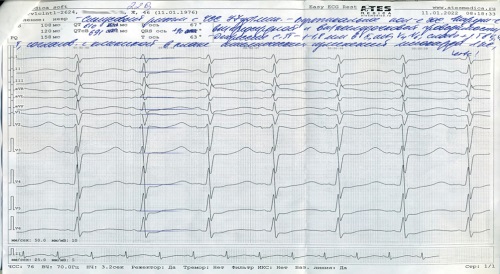
Continuing medical education plays a key role in improving the quality of care, introducing novel diagnostic and treatment methods, and improving clinical outcomes. This article analyzes the role of clinical thin king as a necessary component in improving physicians' professional competencies, as well as the role of continuing professional education institutions. Various forms and methods of training are presented, as well as the stages of establishing institutes and academies for advanced medical training in Russia. A case of primary aldosteronism (Conn's syn drome) in a woman is reported. The disadvantages of late diagnosis are analyzed.
SCIENTIFIC AND PEDAGOGICAL SCHOOLS OF MEDICINE
This article defines the role of academic schools of internal and preventive medicine in the unified educational environment for training physicians in the field of internal medicine. The 5th International Research and Practice Forum "Academic Schools of Internal and Preventive Medicine" is analyzed in relation to the development of a unified educational environment for training general practitioners and internists.
Within the unified educational environment for training general practitioners and internists, academic schools of internal and preventive medicine act as a system-forming factor, ensuring the implementation of the Forum's guiding idea: "A Unified Educational Environment Is a Vector for the Development of Specialist Professionalism".
THE WINNERS OF THE ALL-RUSSIAN COMPETITION OF PEDAGOGICAL IDEAS OF THERAPY TEACHERS
The results of the V All- Russian competition of pedagogical ideas of internal medicine teachers in 2025 have been summed up

ISSN 2619-0125 (Online)